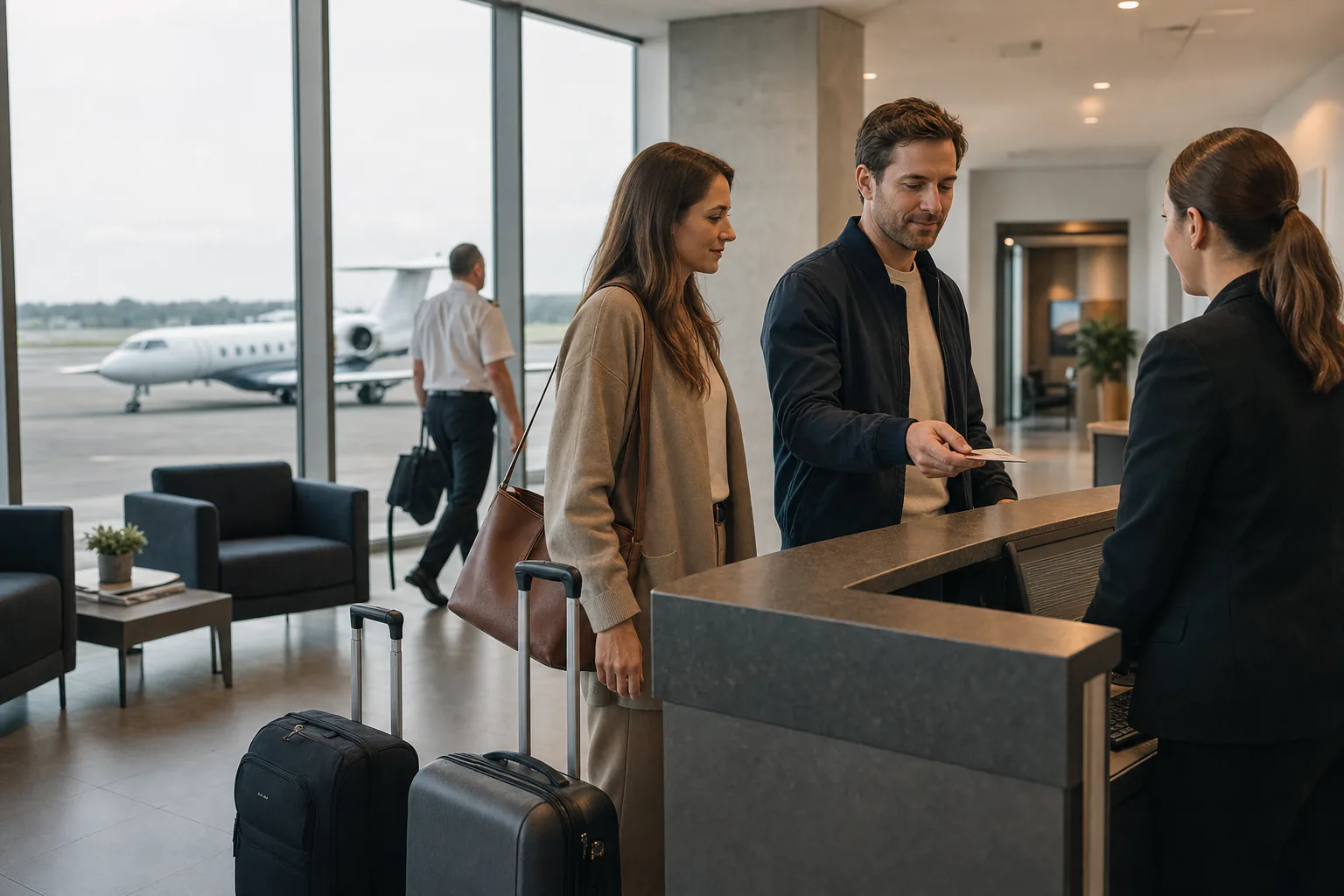
Flying Private for the First Time: What to Expect at the Airport and FBO
Your first private flight usually begins at a general aviation terminal rather than an airline check-in hall. The building may be small and boarding may be quick, but the flight is not casual: the passenger list, identification, baggage, departure point and operator instructions still need to be correct.
First, read the trip sheet all the way through
The most common first-flight mistake is driving to the familiar airline terminal. A city can have several airports, and one airport can have several fixed-base operators. The correct destination is the FBO name and street address shown on the confirmed itinerary or trip sheet.
Before leaving, verify the airport name and code, FBO, local departure time, requested arrival time, on-site contact and ground-transport instructions. If a tail number appears, treat it as helpful identification rather than the address. Aircraft assignments can change; the FBO and current trip contact are what get you to the correct place. Our charter booking overview explains what happens before the trip sheet is issued.
Do not navigate to the airport code alone
Typing the airport into a map can send a driver to the airline terminal, an administration building or the opposite side of the field. Use the complete FBO street address from the final trip documents.
What is an FBO?
A fixed-base operator is an airport business that supports aircraft and their users. Depending on the location, that can include fueling, parking, hangar space, maintenance coordination, passenger lounges, crew facilities, cars and baggage handling. The FAA describes an FBO as a commercial entity providing multiple aeronautical services to the public.
For a charter passenger, the FBO is often the front door to the ramp. Some are polished terminals with several lounges. Others are one quiet room and a desk. Amenities vary, and not every location permits a vehicle to drive to the aircraft.
Departure day, in order
| Stage | What normally happens | What the passenger should do |
|---|---|---|
| Before leaving | The operator and coordination team confirm current trip details, aircraft status and any changed instructions. | Check the latest message or trip sheet, bring the required identification and report passenger or baggage changes. |
| FBO arrival | Reception or the crew identifies the flight and directs the party. Bags may be staged for loading. | Give the lead passenger name or operator name. Keep identification and essential medication with you. |
| Passenger check | Names and identification are matched as required for the operation. Security procedures vary with the aircraft, operator, airport and itinerary. | Use the same legal name supplied for the trip and follow the operator’s instructions. Do not add a traveler at the desk without prior confirmation. |
| Baggage acceptance | The crew verifies the load, compartment fit and restricted-item questions before loading. | Point out batteries, medical devices, sporting equipment, firearms or any item that could require special handling. |
| Crew briefing | The crew covers the cabin, emergency information and relevant flight details. | Listen even if the aircraft feels informal. Ask how seats, belts, doors and the lavatory work before departure. |
| Boarding | Passengers are escorted across the ramp or brought to the aircraft under local procedures. | Stay with the escort, avoid engines and ramp equipment, and let trained personnel handle externally stored bags. |
| Arrival | Bags are unloaded and the FBO or arranged driver receives the party. | Check the cabin for small items and confirm any onward ground contact before leaving the aircraft area. |
How early should you arrive for a private jet?
Use the arrival time provided for the trip. There is no responsible universal answer. A straightforward domestic departure from a familiar FBO may require far less terminal time than an airline flight, while an international departure, large group, firearm declaration, pet movement or special security procedure can require materially more.
Earlier is not infinitely better either. The aircraft or crew may still be repositioning, the FBO may be busy, and a vehicle that arrives on the ramp before the flight is ready can interfere with servicing. If your schedule changes, tell the trip contact rather than deciding that private means the airplane will wait without consequence.
What identification should you bring?
Bring current government-issued identification acceptable for the trip, and make sure the booking uses the matching legal name. International travel requires the passport and any visa or entry document applicable to the traveler and destination. Requirements for minors and special missions should be confirmed in advance.
A private terminal is not a promise that no security rules apply. Part 135 operators can be subject to different TSA security-program requirements based on their operation and aircraft. The practical answer is simple: follow the instructions issued for the confirmed flight and have identification ready.
Your bags do not disappear behind a conveyor belt
On many charter flights, bags move a short distance from the vehicle or lounge to the aircraft. That visibility does not remove loading limits. The crew still needs accurate weights, a safe center of gravity and bags that physically fit the compartment.
Keep passports, medication, keys, fragile items and essential electronics in a small bag that can remain accessible if the crew approves. Some aircraft have external compartments that cannot be reached in flight. If you will need an item before landing, say so before it is loaded.
Private aviation also does not create a dangerous-goods exception. Spare batteries, power banks, aerosols, oxygen devices, dry ice, tools, firearms and other items can be restricted or require operator approval. The FAA’s PackSafe guidance is a useful starting point, and the direct carrier’s decision controls the flight.
What the cabin may—and may not—have
The confirmed aircraft determines the cabin. A light jet may have limited headroom, compact seating and a small lavatory arrangement. A larger aircraft may provide standing room, a full galley, lie-flat seating or a cabin attendant. Wi-Fi availability, speed and coverage should be confirmed rather than assumed.
Catering is equally specific. “Snacks and drinks” can mean a standard aircraft stock, not a custom meal. Dietary requirements, allergies, children’s items and hot food need notice. Ask what was ordered and how it will be served on the proposed aircraft.
Three moments that surprise first-time flyers
The crew may move your seat assignment
Cabin seating is not always open choice. Weight and balance, child restraints, exit access or takeoff-and-landing requirements can affect where passengers sit. The crew has the final word.
A late passenger can affect more than departure time
Crew duty limits, airport operating hours, destination slots, weather and the aircraft’s next commitment keep running while the group waits. Call as soon as a delay becomes possible. A short delay may be manageable; an unreported delay can remove an option the team could have protected.
The aircraft can change
Maintenance and operating schedules can produce a substitution. Review the replacement’s operator, cabin, luggage fit and terms rather than treating the model name as the only change. Our guide to charter disruptions and recovery explains what to check.
A first-flight check before the car leaves
- Open the latest trip sheet, not an earlier quote.
- Navigate to the full FBO address.
- Confirm local time and the requested arrival time.
- Carry identification that matches the passenger information.
- Report any passenger, pet or baggage change before arrival.
- Keep documents, medication and essential items accessible.
- Save the day-of-flight contact number.
- Tell the team immediately if the ground journey starts running late.
Questions first-time private flyers ask
Can I park or drive next to the jet?
Sometimes, but ramp access depends on the airport, FBO, operator and local security procedures. Do not drive through a gate or follow another vehicle without explicit direction.
Do I receive a boarding pass?
Many single-entity charter trips use confirmed trip documents and a passenger list rather than an airline-style boarding pass. The operator or trip coordinator will tell you what to present at the FBO.
What should I wear?
Wear what is appropriate for the trip and the weather on the ramp. Shoes that are stable on aircraft stairs are practical. If the destination is cold or wet, keep a layer accessible rather than burying it in an external baggage compartment.
Know the plan before departure day
Share your route, travelers, bags and special requirements with JetEdCo. We’ll source the charter and keep the confirmed trip details in one place.
Request a Flight →Procedures and amenities vary by operator, aircraft, airport, FBO and itinerary. The selected direct air carrier retains operational control and its instructions govern passenger acceptance, security, baggage and boarding. Factual review completed August 4, 2026.
Research sources
- Federal Aviation Administration, Airport Compliance Manual, Chapter 8 — current definition and role of a fixed-base operator.
- Federal Aviation Administration, Part 135 General Certification Requirements — operator security-program and operational requirements.
- Federal Aviation Administration, PackSafe for Passengers — dangerous goods in passenger baggage.
- National Business Aviation Association, Aircraft Charter Consumer Guide — passenger preparation and charter-consumer questions.